
The 2026 Guide to Texas Property Tax Exemptions & Homestead Relief
What is a Property Tax Exemption?
If you are wondering what a property tax exemption is, the answer is simple: It is a legal provision that removes a portion of your home’s value from taxation. This lowers your taxable value and directly reduces the amount of money you owe the county each year. In Texas, the most common form is the homestead exemption, which provides some money relief for primary residences.
However, if an exemption isn’t enough to solve your tax headache, reach out to our team at Four 19 Properties to explore a fair cash offer that lets you walk away stress-free.
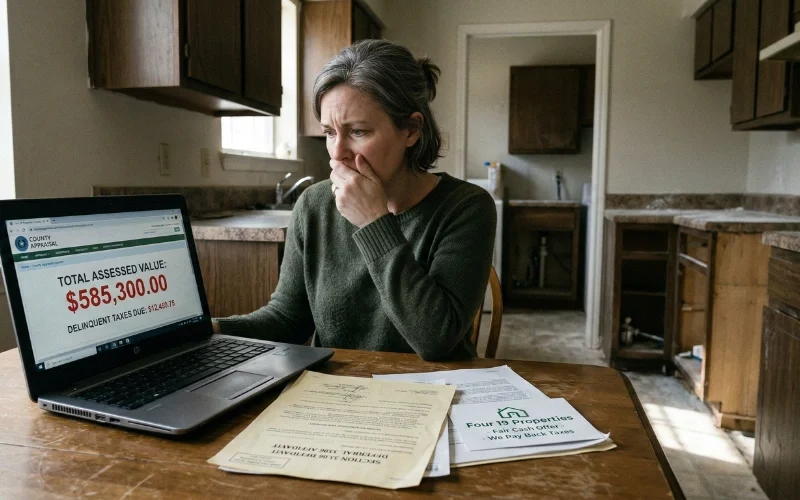
I was sitting at a kitchen table in Tarrant County last week, looking over a homeowner’s massive stack of unopened mail. They were absolutely terrified. The county had just reappraised their house, and the new tax bill was so high it was threatening to push them into foreclosure. They were staring at me, completely overwhelmed, asking, “Neil, who is exempt from paying property taxes in Texas? Because I cannot afford this.”
It breaks my heart, but it happens constantly.
Texas has no state income tax, which is a fantastic marketing pitch for people moving here. But the harsh reality is that the state makes up for it by absolutely hammering us with property taxes. If you don’t know the state of Texas property tax laws, you will get crushed by the local appraisal district.
We are Neil and Shayla Dempsey. As Texas cash home buyers, we help families across the state escape suffocating financial burdens and complex property nightmares. If you are struggling to keep up with the bills, you need to understand exactly how Texas property tax exemptions work in 2026.
Let’s break down the exact forms you need to file, the deadlines you cannot miss, and how to stop the county from taxing you out of your own home. No legal jargon. Just the hard facts.
The 2026 Homestead Exemption: Claiming Your $140,000 Cut
The most powerful weapon you have against the county appraisal district is the homeowners tax exemption, commonly known as the homestead exemption.
If you own the house and use it as your primary residence, you legally qualify for this relief. You cannot claim it on a rental property or a vacation home. It only applies to the roof over your head.
In recent years, the Texas Legislature has made massive moves to provide relief to homeowners. For 2026, you need to know about the jump to the $140,000 limit. This means if your home is appraised at $400,000, the school district cannot tax you on that full amount. They must subtract $140,000 right off the top, meaning you are only taxed on $260,000. This saves the average homeowner over a thousand dollars a year.
But the county is not going to just hand this to you out of the goodness of their hearts. You have to actively claim it.
To get your Texas homestead tax exemption, you must file Form 50-114 (the Application for Residential Homestead Exemption) with your local county appraisal district. You can usually download the tax exempt form Texas directly from their website, fill it out, and mail it in with a copy of your Texas driver’s license. The address on your license must perfectly match the address of the home.
If you live in an area with notoriously high taxes—and anyone tracking the Fort Worth property tax rate knows exactly what I mean—getting this form filed is the single most important financial move you can make this year.
Special Exemptions for Seniors, Veterans, and Heir Properties
So, exactly who is exempt from paying property taxes in Texas? While a standard homeowner gets a chunk of their value removed, certain groups qualify for massive additional relief, or even total exemption.
Over-65 & Disabled: The New $60,000 Bonus and Tax Freezes
If you are 65 or older, or if you meet the strict legal definition of disabled, you get special treatment.
First, the property tax exemption for seniors in Texas grants you an additional $60,000 off your home’s taxable value for school taxes. But the real magic is the tax freeze.
When you file your over-65 exemption, the amount of school taxes you pay is permanently frozen. Even if property values in Dallas skyrocket over the next ten years, the actual dollar amount you pay to the school district will never exceed the amount you paid in the year you qualified. It is the ultimate shield against inflation.
The Downside of the Freeze: However, there is a major catch you need to prepare for. This freeze is tied to you, not the house. If you pass away or sell the property, that freeze instantly disappears (unless it transfers to a qualifying surviving spouse who is at least 55). Once the original owner is gone, the county immediately unfreezes the home and reassesses it at its current, modern-day market value. For heirs inheriting a home that has been frozen since 2005, the new property tax bill can easily triple or quadruple overnight, creating a massive financial shock for the grieving family.
100% Disabled Veterans: Total Exemption Qualifications
When people ask me if anyone is completely exempt from property tax, I point them to our veterans.
Texas property tax exemptions for veterans are some of the strongest in the country. If you are a veteran who receives 100% disability compensation from the VA due to a service-connected disability, your primary residence is 100% exempt from property taxes. You pay zero. Nothing.
If your disability rating is less than 100%, you still qualify for a partial exemption based on your specific percentage, which scales down proportionately.
Heir Property: Lowering Taxes Without a Formal Deed
This is a massive issue we see all the time up in Denton and surrounding areas. A parent passes away, and the kids move into the house. But they never go through formal probate, so the deed is still in the deceased parent’s name.
For years, these families couldn’t get the property tax exemption Texas offered because their name wasn’t officially on the title.
The law has changed. Texas now allows heir property owners to claim the homestead exemption even without a formally cleared deed. As long as you can prove you are a legal heir, you live in the home as your primary residence, and you submit the required affidavits with your Form 50-114, you can secure the exemption and lower your tax burden while you figure out the legal paperwork.
Navigating Deadlines, Deferrals, and Moving
Understanding property tax exemptions in Texas is only half the battle. You also have to know the strict rules of the calendar.
The April 30th Deadline (And How to File Late)
The standard deadline to file your state of Texas property tax exemptions application is April 30th of the tax year.
However, life gets busy. If you completely forgot to file your property tax exemptions, do not panic. Texas law allows you to file a late application for up to two years after the delinquency date. If the county approves your late application, they will actually issue you a refund for the extra taxes you already paid.
Section 33.06 Tax Deferrals: Delaying Payments for Seniors
This is the most misunderstood safety net in the Texas tax code.
If you are over 65 or disabled, and you simply cannot afford to pay your property taxes, you can file an affidavit under Section 33.06 of the Texas Property Tax Code to defer your taxes. This legally stops the county from foreclosing on your house or trying to collect the debt.
But here is the crucial detail most people miss: A deferral is not a cancellation. The taxes are not erased.
While you are living there, the unpaid taxes continue to accrue at a massive 5% interest rate every single year. When you eventually move out into an assisted living facility, or when you pass away, that entire mountain of back taxes plus interest instantly becomes due. Specifically, your heirs have exactly 181 days to figure out who pays house sale taxes in Texas and settle the massive debt with the county, or the house goes to the foreclosure auction.
Portability: Transferring Your Tax Ceiling to a New House
If you are over 65 and you currently have a frozen tax ceiling, you don’t lose it just because you want to downsize.
Texas allows tax ceiling portability. If you sell your large family home and buy a smaller condo, you can request a certificate from your old appraisal district and transfer the percentage of your tax freeze to the new property. This prevents seniors from being financially trapped in homes that are too big for them, and it plays a huge role in planning around the capital gains tax in Texas when selling a primary residence.
When Taxes Are Too High: Selling As-Is to Four 19 Properties
Sometimes, an exemption just isn’t enough.
If you inherited a house with years of unpaid taxes, or if you utilized a Section 33.06 deferral and suddenly find yourself facing a massive tax bill that is due in 181 days, the stress can be paralyzing. The county is relentless. If you don’t pay, they will seize the property and sell it on the courthouse steps, wiping out your family’s equity entirely.
You don’t have to let the county take your house.
At Four 19 Properties, Shayla and I specialize in buying problem properties. If the tax burden has become unbearable, or if you are trying to sell a house in bankruptcy in Texas to clear your debts, we offer a fast, clean exit.
We buy houses entirely as-is. We don’t care if the roof is leaking or if the property taxes are five years past due. When we make you a fair cash offer, we factor all of those back taxes and liens into the math. We pay the county directly at closing out of our own pocket. You don’t have to write a check, you don’t have to pay real estate commissions, and you don’t have to live in fear of the tax assessor anymore.
Conclusion & Next Steps
Understanding the property tax exemptions Texas offers is your absolute best defense against the rising cost of homeownership.
Take 15 minutes today to check your local county appraisal district website. Verify that your homestead exemption is active. If it isn’t, download Form 50-114 immediately. Do not leave your hard-earned money sitting on the table for the government to take.
But if you are already buried under a mountain of delinquent property taxes, waiting for an exemption won’t save you. You need a fast, reliable exit strategy.Take control of your financial future today. Reach out to us at Four 19 Properties. Fill out the short form on our website, and we will personally review your situation. We will give you a clear, honest assessment of your property and a guaranteed cash offer so you can settle up with the county, protect your credit, and finally move forward with your life.
Popular Posts