

When Is the Best Time to Sell a House in Texas? (2026 Update)
Discover the Prime Months for Selling Your Texas Property
While conventional wisdom suggests listing in late Spring (May-June) to capture families moving before the school year, 2026 real estate market data shows that waiting often costs sellers more in “holding costs” than they gain in sales price. For homeowners with vacant or distressed properties, the best time to sell is immediately (January-March) to avoid the high cost of property taxes, vacant home insurance, and potential storm damage during the volatile spring weather.
I’ve been asked this question at least a thousand times. Usually, we are standing in a living room in Arlington, surrounded by moving boxes, or sitting on a front porch in Dallas-Fort Worth, watching the cars go by.
“Neil, should we list it now, or wait until Spring?”
It’s a fair question. You hear the news. You see the “For Sale” signs popping up like bluebonnets in April. Conventional wisdom says you wait for the “Prime Season” to get the most money but determining the best month to sell a house in Texas depends on your property, situation, and goals..
But here is the thing about conventional wisdom: It usually doesn’t account for your bank account.
Shayla and I have been buying houses since 2006, and I can tell you that waiting for the “perfect time” is often the most expensive decision a homeowner can make.
Let’s look at the real numbers for 2026.
The Hidden Cost of Waiting (The Math)
Before we talk about “seasonal trends,” “curb appeal,” or the color of the front door, we need to look at your wallet.
Most folks think that holding a house for three or four months is free. They think, “Well, the mortgage is paid off, so it doesn’t cost me anything to wait.”
That is almost never true.
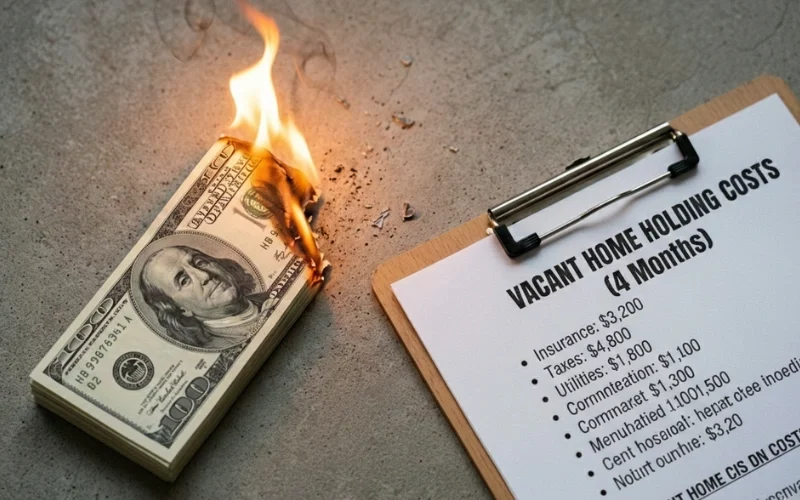
Every day you own a house, it costs you money. Even if the mortgage is zero, the meter is still running. We call this “The Burn Rate.” And in 2026, the cost of insurance—specifically for vacant homes—has skyrocketed.
If you move out and leave the house empty, your standard policy usually won’t cover you. You need a Vacant Dwelling Policy, and those are brutal. They are often 50-60% more expensive than standard policies because the risk of vandalism or unnoticed leaks is higher.
If you decide to wait 4 months for the “Spring Market,” here is what that actually costs you on an average Texas home:
| Expense | Monthly Cost | 4-Month Cost |
| Mortgage Payment | $1,800 | $7,200 |
| Property Taxes | $500 | $2,000 |
| Vacant Home Insurance | $250 | $1,000 |
| Utilities (Electric/Water/Gas) | $350 | $1,400 |
| Maintenance (Lawn/Repairs) | $200 | $800 |
| TOTAL “WAITING COST” | $3,100 | $12,400 |
That is over twelve thousand dollars of equity that vanishes into thin air while you wait for a “better offer.”
Think about that. If you wait until May and sell the house for $10,000 more, you actually lost $2,400. And that doesn’t even account for the stress of keeping the house clean, the risk of something breaking (like a water heater), or the fluctuating interest rates that could kill your buyer’s financing.
Don’t let the calendar fool you. The best time to sell is often simply when you stop losing money.
The “Golden Window” (And Why It Might Be a Trap)
Real estate agents love to talk about the “Golden Window”—that sweet spot between late April and early June when buyers are frantic.
And they aren’t wrong; there is more buyer activity then. Families want to move before the school year starts. The weather is nice. The grass is green.
But here is the danger no one talks about: The 60-Day Lockup.
When you list a house on the market, you are usually signing a contract with a realtor for 6 months. But more importantly, once you accept an offer, you are locked in for 45 to 60 days while the buyer tries to get a loan.
If you list in the “Prime Season” of May, you might go under contract in June.
But what happens if the buyer’s financing falls through in July?
Now it’s August. You’ve missed the “Golden Window.” You have a stale listing. And you are back to square one, but now you are three months deeper in debt.
Waiting for the perfect season is a gamble. And in this 2026 market, with interest mortgage rates bouncing around, a “pending” sale is not a “closed” home sale.
Selling in the Texas Heat: The Mold & Money Problem
If you miss that Spring window and end up selling in late summer, you are fighting a new enemy: The Texas Heat.
I’m not just talking about sweating through your shirt during a showing. I’m talking about what happens to a vacant house in DFW when it’s 105 degrees outside.
You have two choices, and both of them are bad:
Choice A: You turn the AC off to save money.
If you leave a house unconditioned in August, the humidity inside the house spikes. The wood floors swell and buckle. The drywall absorbs moisture. And within 72 hours, mold starts to bloom. I’ve walked into vacant houses that smelled like a locker room just because the AC was off for a week. Buyers can smell that immediately. It smells like neglect.
Choice B: You keep the AC running.
Cooling an empty, poorly insulated house in the Texas summer will run you $300 to $400 a month.
That’s just burning cash to keep an empty living room at 78 degrees. You are paying for comfort that no one is enjoying.
The “Back-to-School” Slump (September & October)
Once school starts, the market demand changes.
Families with kids—your biggest buyer pool—are done. They aren’t moving. They are focused on football practice, band rehearsals, and homework. They are settling in for the semester.
If you list in September, you are usually targeting a different kind of buyer:
- Relocation Buyers: People moving for work who have to buy.
- First-Time Buyers: Young couples without kids who aren’t tied to the school calendar.
- Investors: People like us who buy year-round.
This doesn’t mean you can’t sell. But it means you have to be realistic. The bidding wars of May are gone. You might get one offer instead of five. And that offer is going to be pickier. They know you are selling in the “off-season,” and they will try to negotiate harder.
The Holiday Market (November & December)
Most people assume you can’t sell a house during the winter holidays.
“Everyone is busy with Thanksgiving and Christmas. No one wants to move.”
That’s true for looky-loos. But it’s not true for serious buyers.
Think about it. Who goes house hunting in December? Who drags their family out in the cold (or the rain, since this is Texas) to look at houses?
Someone who needs to buy.
Maybe they are relocating for a job starting in January. Maybe they are going through a divorce. Maybe they need to buy for tax reasons before the year ends.
November and December buyers are serious. They aren’t tire kickers. They are motivated.
The downside? There are fewer of them. If you need a quick sale during the holidays, you can’t rely on luck. You need a sure thing. Listing during the holidays can be stressful—keeping the house clean for showings while you are trying to host family dinners is a nightmare.
The 2026 Texas Real Estate Forecast: The Insurance Crisis
So, what does 2026 look like?
If you read the reports, everyone talks about mortgage interest rates and housing inventory. But there is a silent deal-killer happening right now that most sellers don’t see coming.
The Insurance Crisis.
In 2026, the biggest hurdle for buyers isn’t just the interest rate—it’s the Insurance DTI.
Lenders are killing deals at the last minute because the insurance quote came back at $4,000/year, throwing off the buyer’s Debt-to-Income (DTI) ratio. If your roof is over 15 years old, your buyer might not be able to get insurance at all.
We are seeing retail deals fall apart constantly because of this. A buyer falls in love with a house, makes an offer, and then finds out no insurance company will write a policy because of the age of the roof or previous storm claims.
This makes listing an older home on the market incredibly risky. You might spend thousands on repairs just to get lowball offers from buyers who are scared of the insurance costs.
We are seeing a trend where “perfect” houses sell fast, and older homes with any deferred maintenance sit on the market for months.
And remember the math from the beginning of this article: Sitting = Losing Money.
Why Selling to Four 19 Properties Beats Waiting
We don’t care what month it is or local market conditions. We buy houses in January, and we buy them in August.
Whether you are in Dallas, dealing with a property tax hike, or you have a rental in Fort Worth that just went vacant, we offer a different path.
When you sell to Four 19 Properties:
- No Holding Costs: We can close in as little as 7 days. You stop the bleeding immediately.
- No “Lockup”: Our offers are cash. We don’t need a bank to approve us. When we say we’ll buy it, we buy it.
- No Repairs: We buy “As-Is.” If the AC is broken, that’s our problem, not yours.
- No Insurance Headaches: We insure our own properties. We don’t need a lender to approve the roof age.
- No House Showings: You don’t have to leave your house for strangers to walk through it.
Real estate shouldn’t be a gambling game. It should be a solvable problem.
If you are tired of doing the math and seeing red, give us a call. We’ll make you a fair, cash offer, and you can be done with the house—and the payments—by next week.
Popular Posts